Romps, Wet-bulb temperature from pressure, relative humidity, and air temperature, JAMC, 2026
Paper
Code
Description
The wet-bulb temperature is used to measure the relative humidity and quantify heat stress. Unfortunately, there are many different definitions of the wet-bulb temperature and many different algorithms used to calculate it, and there is often ambiguity about which definition is being used or should be used. This diversity of definitions and algorithms would not pose a problem if they all gave the same answer, but, as shown here, they give values that can differ from each other by several degrees.
In this paper, precise definitions are given for the various wet-bulb and ice-bulb temperatures, and equations are derived for each of them in terms of pressure, relative humidity, and air temperature. For the thermodynamic wet-bulb temperature, for which good empirical data exists, the resulting expression agrees to within 0.05 K, in contrast to the existing algorithms, whose maximum errors range from 0.3 K to 2 K. Finally, a curious bistability is reported here: there is a range of temperatures and humidities for which both a wet bulb and an ice bulb are stable. The code to calculate these wet-bulb and ice-bulb temperatures is now available as the wetbulb function in the heatindex package, available for R through CRAN and for Python through PyPI; see heatindex.org for how to install with a single instruction.
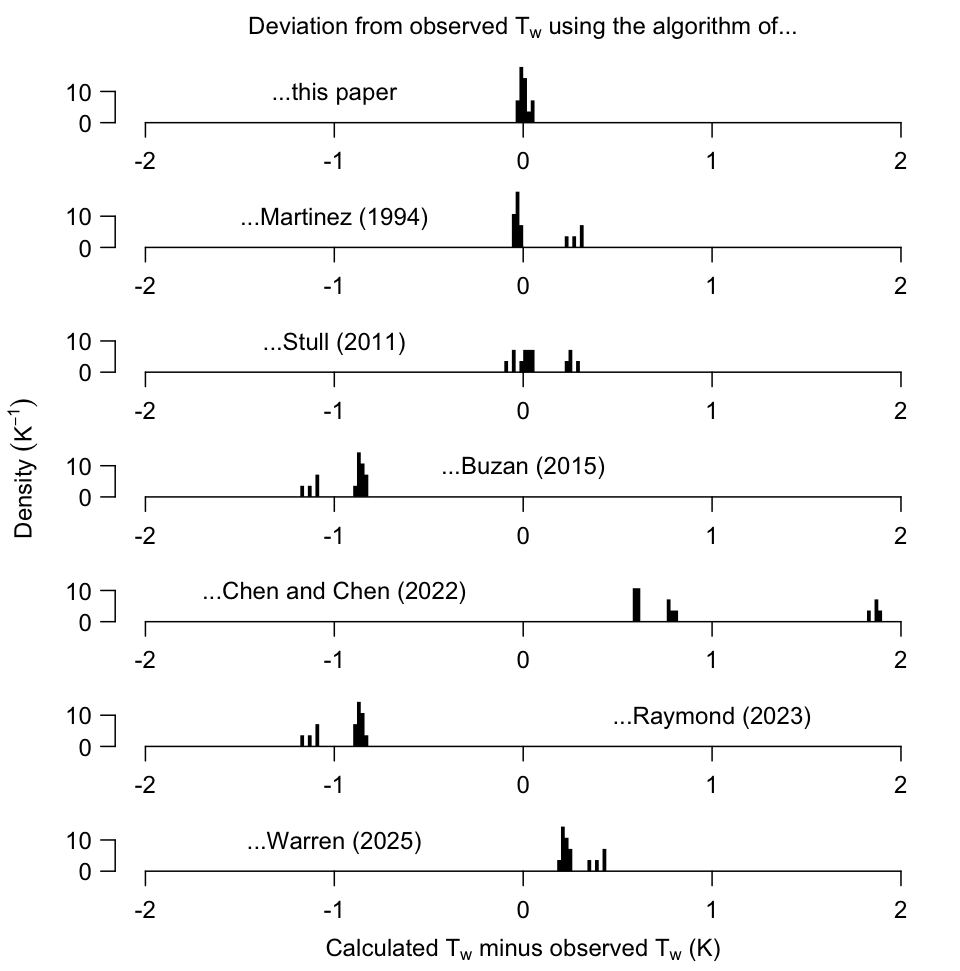
Error, in K, relative to the empirical values of the thermodynamic wet-bulb temperature measured by Greenspan and Wexler for (row 1) this paper and (rows 2–7) other available equations and algorithms.